Xiamen, Tulou & Quanzhou: Fujian\'s Maritime Silk Road
A car-free island of colonial villas, the Hakka people\'s extraordinary earthen roundhouses, and Quanzhou — the port Marco Polo called \'the Alexandria of the East.\'
5–6 Days
The perfect pace for Fujian's three UNESCO sites — enough time to go deep without feeling rushed.
Xiamen → Gulangyu → Nanjing Tulou → Quanzhou → Xiamen
Connected by high-speed train and bus. Xiamen has an international airport with flights across Asia.
Gulangyu Island, Fujian Tulou, Kaiyuan Temple
A car-free colonial island, extraordinary earthen roundhouses, and the Maritime Silk Road's start.
The Journey
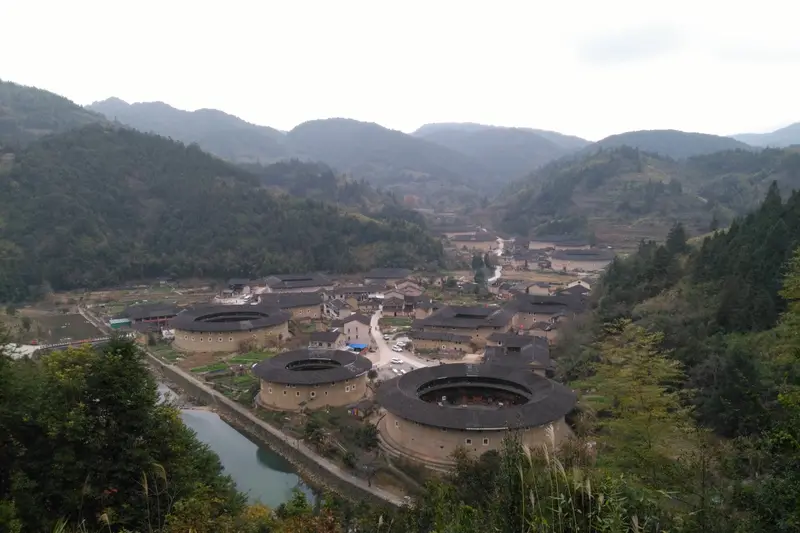
Fujian province faces Taiwan across the strait and has always been China\'s maritime frontier. This route connects three of its UNESCO sites: Gulangyu Island, a car-free island of colonial villas, gardens, and piano museums; the Fujian Tulou — enormous circular earthen buildings that housed entire Hakka clans for centuries; and Quanzhou, the starting point of the Maritime Silk Road, added to the UNESCO list in 2021 as \'Quanzhou: Emporium of the World in Song-Yuan China.\'
Day 1: Xiamen
Fly into Xiamen Gaoqi Airport (XMN). Xiamen (厦门, 'Amoy' in the old colonial name) is a pleasant coastal city that was one of the first treaty ports opened to foreign trade in 1842. Afternoon: Zhongshan Road (中山路) — a pedestrian shopping street with colonial arcade architecture. Visit Nanputuo Temple (南普陀寺, free) — a Tang dynasty Buddhist temple at the foot of Wulao Mountain. Evening: seafood dinner on Huandao Road.
Local tip: Xiamen is one of China's most liveable cities — clean air, good food, and a relaxed pace. The city is built on an island connected to the mainland by bridges and a BRT (Bus Rapid Transit) system. The BRT is the easiest way to get around — it is an elevated bus-only road, effectively an above-ground metro.
Day 2: Gulangyu Island
Take the 10-minute ferry from Xiamen to Gulangyu Island (鼓浪屿). Gulangyu is a car-free island of colonial villas, tropical gardens, and narrow lanes. It was a foreign concession from 1903-1945, and the architecture reflects this: British consulates, Japanese hospitals, Spanish cathedrals. Visit Shuzhuang Garden (菽庄花园) — a seaside garden with a piano museum housing 100 antique pianos. Climb Sunlight Rock (日光岩) for the island panorama. Evening: ferry back to Xiamen.
Local tip: Gulangyu ferry tickets sell out in summer and on weekends. Book on the official WeChat mini-program (厦门轮渡). The ferry from Dongdu Jetty (for tourists) has a modest fee; the ferry from Lundu Jetty is for locals only and tourists cannot use it. The island has no cars, no bikes — you will walk everywhere. Wear comfortable shoes.
Day 3: Xiamen → Nanjing Tulou
Take a 3-hour bus from Xiamen to Nanjing Tulou cluster. The Nanjing Tulou are the most scenic group. Visit Tianluokeng Tulou Cluster (田螺坑) — five tulou arranged in a pattern locals call 'four dishes and a soup' (four round buildings around one square). Then Yuchang Lou (裕昌楼) — a 700-year-old tulou whose pillars lean at 15° (it is called the 'Leaning Tower of Pisa of Fujian'). Finish at Taxia Village (塔下村) — a Hakka village along a stream with a unique stone flagpole forest honouring successful scholars. Stay overnight in a tulou guesthouse.
Local tip: Stay overnight in a tulou — several have been converted into simple guesthouses. The rooms are basic (shared bathrooms, thin walls) but the experience of waking up inside a 500-year-old earthen fortress is unforgettable. The Hakka hosts will cook dinner for you — home-style Hakka food: salt-baked chicken, stuffed tofu, and yam noodles.
Day 4: Tulou → Xiamen → Quanzhou
Morning: visit Hekeng Tulou Cluster (河坑, quieter, less touristy) or Yunshuiyao Ancient Village (云水谣, a riverside village with a thousand-year-old banyan tree used in the film 'The Knot'). Afternoon: bus back to Xiamen (3 hrs), then 30-minute high-speed train to Quanzhou. Check into hotel. Evening: walk Quanzhou's old town — the Tumen Street area with its mosque, temple, and church within walking distance of each other.
Local tip: Quanzhou is inexpensive by Fujian standards, with comfortable hotels near the old town. The city was recently discovered by Chinese tourists after its 2021 UNESCO listing but still sees very few Western visitors.
Day 5: Quanzhou
Quanzhou was the starting point of the Maritime Silk Road and, during the Song-Yuan period (10th-14th centuries), one of the world's largest ports. Start at Kaiyuan Temple (开元寺, free) — a Tang dynasty Buddhist temple with twin stone pagodas that have survived since the 13th century. Behind the main hall, two stone pillars are carved with Hindu deities — a legacy of Tamil traders who lived here 700 years ago. Visit the Qingjing Mosque (清净寺) — China's oldest surviving mosque, built in 1009 AD. Lunch: Quanzhou oyster omelette (海蛎煎) and 'vermicelli paste' (面线糊) — rice noodles in a thick seafood broth. Afternoon: Maritime Museum (free) and the ancient Maritime Silk Road ship excavated from Quanzhou Bay. Evening: train back to Xiamen (30 min).
Local tip: Quanzhou's religious diversity in the Song-Yuan period was remarkable: Buddhist temples, Hindu shrines, a mosque (1009 AD), a Manichaean temple (the only surviving Manichaean statue in the world is near Quanzhou), a Daoist temple, and a Catholic cathedral. The Kaiyuan Temple's Hindu pillars are unique in China — Tamil merchants from the Chola dynasty donated them in the 13th century.
Day 6: Xiamen → Fly Out
If your flight is in the evening: visit the Xiamen Botanical Garden or cycle the Huandao Road coastal path (bikes easily rented along the route). Buy oolong tea (Fujian is the home of Tieguanyin and Dahongpao) and dried seafood as souvenirs.
Local tip: Fujian tea: Tieguanyin (铁观音, Iron Goddess of Mercy) — a floral oolong from Anxi with a delicate orchid fragrance — and Dahongpao (大红袍, Big Red Robe) — a legendary rock oolong from Wuyi Mountain with a deep, mineral-rich character. Buy at a tea market, not a tourist shop — the Xiamen Tea Market (厦门茶叶市场) is wholesale.
This is a suggested itinerary. Every journey we design is tailored to your interests, pace, and budget.
Ready to Plan Your China Journey?
Tell us about your dream trip. We will send you a personalized proposal — no obligation, no pressure.
Or call us: +44 20 XXXX XXXX